Introduction#
Hinode is a JAXA solar observatory, built with NASA, the UK Space Agency, and ESA, which has been observing the Sun since 2006 [Kosugi et al., 2007].
This Python package downloads Hinode observations and represents them
using named_arrays,
a named tensor implementation with astropy.units.Quantity support.
So far it supports the Level 1 images of the
X-Ray Telescope (XRT) [Golub et al., 2007], in hinode.xrt,
along with what a differential emission measure needs:
the temperature response of each filter,
hinode.xrt.temperature_response(),
the visible light leaking into each pixel,
hinode.xrt.Filtergram.leak,
and the uncertainty of each pixel,
hinode.xrt.Filtergram.uncertainty().
The pointing of each image is corrected with the co-alignment databases of
SolarSoft, so that it lines up with AIA,
hinode.xrt.Filtergram.coalignment.
Installation#
This package is published to PyPI and can be installed using pip.
pip install hinode
API Reference#
Download and analyze observations from the Hinode satellite. |
Examples#
Load the XRT images taken through the Al_poly filter while the EUV Snapshot Imaging Spectrograph (ESIS) was observing the Sun on 2019 September 30, and display the last one.
import matplotlib.pyplot as plt
import astropy.units as u
import astropy.visualization
import named_arrays as na
import hinode

# Download the images and load them into memory
images = hinode.xrt.open(
    time_start="2019-09-30T18:06:11",
    time_stop="2019-09-30T18:11:01",
    filter="Al_poly",
)

# Select the last image
image = images[{images.axis_time: ~0}]

# Display the image
unit = image.inputs.position.x.unit
with astropy.visualization.quantity_support():
    fig, ax = plt.subplots(figsize=(6, 6), constrained_layout=True)
    na.plt.pcolormesh(
        image.inputs.position.x,
        image.inputs.position.y,
        C=image.outputs,
        ax=ax,
        cmap="gray",
        norm="asinh",
        vmin=0 * u.DN / u.s,
        vmax=100 * u.DN / u.s,
    )
    ax.set_aspect("equal")
    ax.set_title(image.inputs.time.ndarray)
    ax.set_xlabel(f"helioprojective $x$ ({unit:latex_inline})")
    ax.set_ylabel(f"helioprojective $y$ ({unit:latex_inline})")
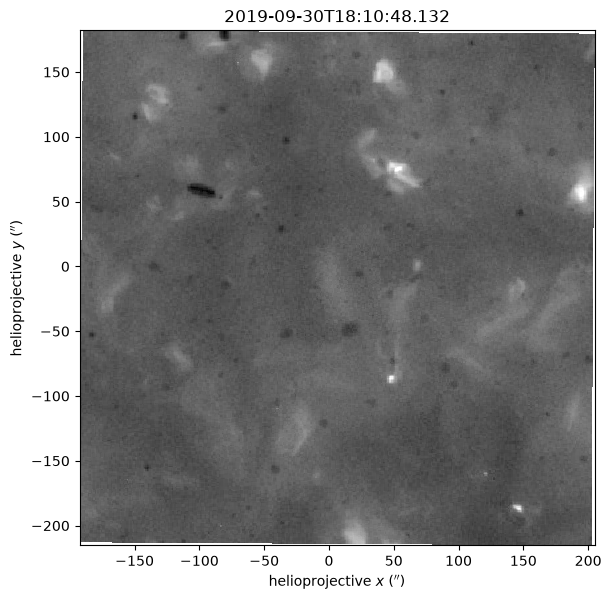
Tutorials#
Citation#
If you use hinode in your research, please cite it.
The citation metadata is kept in
CITATION.cff,
which the “Cite this repository” button on the
GitHub page
can export as BibTeX or APA.
Every release of hinode is archived on Zenodo with its own DOI.
The concept DOI,
10.5281/zenodo.23249959,
always resolves to the latest version,
and the Zenodo page lists the DOI of every version.
Please include the version of hinode that you used,
which is given by importlib.metadata.version("hinode").
The BibTeX entry below uses the concept DOI.
To cite a specific version instead,
replace doi with the DOI of that version.
@software{hinode,
  author = {Smart, Roy T.},
  title = {hinode},
  version = {X.Y.Z},
  doi = {10.5281/zenodo.23249959},
  url = {https://github.com/sun-data/hinode},
}
References#
P. S. Athiray and Amy R. Winebarger. Can emission measure distributions derived from extreme-ultraviolet images accurately constrain high-temperature plasma? The Astrophysical Journal, 961(2):181, 2024. doi:10.3847/1538-4357/ad1837.
P. F. Boerner, P. Testa, H. Warren, M. A. Weber, and C. J. Schrijver. Photometric and thermal cross-calibration of solar euv instruments. Solar Physics, 289(6):2377–2397, 2014. doi:10.1007/s11207-013-0452-z.
Paul Boerner, Christopher Edwards, James Lemen, and others. Initial calibration of the atmospheric imaging assembly (aia) on the solar dynamics observatory (sdo). Solar Physics, 275(1-2):41–66, 2012. doi:10.1007/s11207-011-9804-8.
M. R. Calabretta and E. W. Greisen. Representations of celestial coordinates in fits. Astronomy & Astrophysics, 395(3):1077–1122, 2002. doi:10.1051/0004-6361:20021327.
G. Del Zanna, B. Mondal, Y. K. Rao, N. P. S. Mithun, S. V. Vadawale, K. K. Reeves, H. E. Mason, A. Sarkar, P. Janardhan, and A. Bhardwaj. Multiwavelength observations by xsm, hinode, and sdo of an active region. chemical abundances and temperatures. The Astrophysical Journal, 934(2):159, 2022. doi:10.3847/1538-4357/ac7a9a.
L. Golub, E. DeLuca, G. Austin, J. Bookbinder, and others. The x-ray telescope (xrt) for the hinode mission. Solar Physics, 243(1):63–86, 2007. doi:10.1007/s11207-007-0182-1.
A. R. Kobelski, S. H. Saar, M. A. Weber, D. E. McKenzie, and K. K. Reeves. Calibrating data from the hinode/x-ray telescope and associated uncertainties. Solar Physics, 289(7):2781–2802, 2014. doi:10.1007/s11207-014-0487-9.
T. Kosugi, K. Matsuzaki, T. Sakao, T. Shimizu, and others. The hinode (solar-b) mission: an overview. Solar Physics, 243(1):3–17, 2007. doi:10.1007/s11207-007-9014-6.
James R. Lemen, Alan M. Title, David J. Akin, and others. The atmospheric imaging assembly (aia) on the solar dynamics observatory (sdo). Solar Physics, 275(1-2):17–40, 2012. doi:10.1007/s11207-011-9776-8.
N. Narukage, T. Sakao, R. Kano, H. Hara, and others. Coronal-temperature-diagnostic capability of the hinode/x-ray telescope based on self-consistent calibration. Solar Physics, 269(1):169–236, 2011. doi:10.1007/s11207-010-9685-2.
Jacob D. Parker, Roy T. Smart, Charles Kankelborg, Amy Winebarger, and Nelson Goldsworth. First flight of the euv snapshot imaging spectrograph (esis). The Astrophysical Journal, 938(2):116, 2022. doi:10.3847/1538-4357/ac8eaa.
Joseph Plowman and Amir Caspi. A fast, simple, robust algorithm for coronal temperature reconstruction. The Astrophysical Journal, 905(1):17, 2020. doi:10.3847/1538-4357/abc260.
A. Takeda, K. Yoshimura, and S. H. Saar. The hinode/xrt full-sun image corrections and the improved synoptic composite image archive. Solar Physics, 291(1):317–333, 2016. doi:10.1007/s11207-015-0823-8.
Keiji Yoshimura and David E. McKenzie. Calibration of hinode/xrt for coalignment. Solar Physics, 290(8):2355–2372, 2015. doi:10.1007/s11207-015-0746-4.